
Why Commercial Indoor Golf is the Must-Have Amenity for US Businesses in 2026
The indoor golf simulator business is no longer a niche. Indoor simulator participation in the US grew over 30% between 2021 and 2024, and operators across the country are taking notice. From sports bars in Chicago to luxury apartment complexes in New York, venues that installed simulators early are already seeing the payoff — higher revenue per square foot, longer guest dwell times, and a repeatable reason for customers to come back.
If you're evaluating whether a commercial simulator makes sense for your space, here's what you need to know.
Space Efficiency: Making Every Square Foot Work Harder
Real estate costs in US urban markets are unforgiving. A simulator bay that sits idle is a liability — which means the technology you choose needs to work reliably in the space you actually have.
Most traditional radar-based systems (like Trackman or Mevo+) need significant depth behind the golfer to accurately capture ball flight. That's fine for a dedicated golf facility with 20+ foot ceilings and open floor plans. It's a problem for a sports bar back room or a hotel amenity lounge.
Camera-based systems are more compact-friendly and don't require the same depth behind the golfer that radar systems do. GOLFJOY uses high-speed stereoscopic camera tracking specifically engineered for tighter commercial spaces — no radar interference issues, no complex environmental requirements.
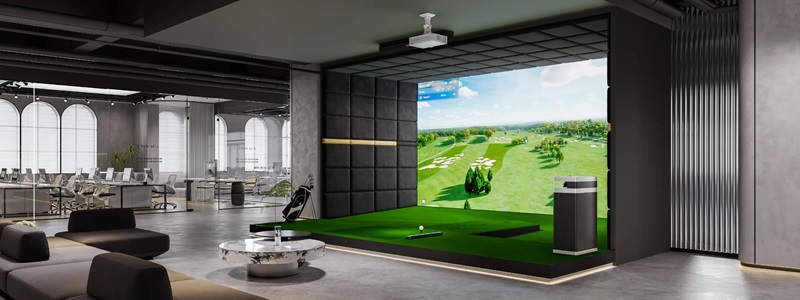
Recommended Room Dimensions for US Commercial Venues:
| Setup | Length | Width | Height |
|---|---|---|---|
| Single-Sided | 3.8m (12.5 ft) | 5.8m (19 ft) | 2.8m (9.2 ft) |
| Double-Sided | 4.8m (15.8 ft) | 5.8m (19 ft) | 2.8m (9.2 ft) |
If you're working with a tighter footprint, reach out — we've installed functional bays in spaces most vendors would turn away.
The Revenue Model Actually Works
Facilities integrating social golf experiences — sports bars, entertainment venues — have seen revenue per square foot increase 25–35% compared to traditional ranges. That's not a coincidence. Simulators extend dwell time, drive food and beverage sales, and give customers a reason to book ahead instead of just walking in.
Here's how US operators are monetizing their bays right now:
- Hourly rentals — the most straightforward model; $40–$80/hr per bay depending on market
- Corporate events and leagues — high-margin bookings that fill off-peak hours
- Resident amenity programs — luxury apartment complexes and HOAs adding simulators as a differentiator to justify premium rents
- Membership/subscription tiers — monthly recurring revenue that smooths out seasonal swings
Sports bars and lounges are using simulators to attract a younger, social crowd, while corporate offices are adopting them as team-building tools and wellness perks. These aren't the same customer — and that's the point. A well-positioned simulator bay serves multiple segments throughout the week.

Why Operators Are Switching to Camera-Based Technology
The US commercial simulator market has been dominated by radar systems for years. They work well outdoors and in large open facilities. But radar comes with real trade-offs in indoor commercial environments:
- Requires more physical depth to track ball flight accurately
- Susceptible to interference from metal structures and HVAC systems common in commercial builds
- Frequent recalibration needs add maintenance overhead and downtime
GOLFJOY's camera-based tracking eliminates these pain points. The system is designed for 24/7 commercial use — the kind of high-volume environment where downtime costs you real money. No complex calibration routines. No environmental interference. Stable, consistent performance whether it's a Tuesday afternoon lesson or a Saturday night corporate buyout.
FAQ: What Commercial Operators Actually Ask Us
How much space do I need?
Our simulator setup is highly adaptable, but for a fully functional Single-Sided (Right or Left-handed) bay, the minimum space required is 12.47 ft (Length) x 18.96 ft (Depth) x 9.19 ft (Height), which equals a total area of 237 sq ft.
If you're unsure whether your space meets these requirements, we'll give it to you straight — no pressure.
Radar vs. camera-based: which is better for my venue?
For indoor commercial settings, camera-based wins on reliability and space efficiency. Radar is excellent for open-air ranges and high-ceiling facilities. If you're working with a traditional commercial build, the interference and depth requirements of radar systems make camera-based the more practical choice.
What does the installation process look like?
We run every US installation through an 8-step process:
- Needs Assessment
- Site Visit & Demo
- Onsite Measurement
- Design & Blueprinting
- Contract Signing
- Professional Installation
- Customer Acceptance
- Ongoing After-Sales Support
No handoff to a third-party installer. Our team handles the full process from site assessment through commissioning.
What kind of ROI should I expect?
That depends on your market, pricing, and how aggressively you program the space. We're happy to walk through the numbers with you during a site assessment — realistic numbers, not best-case projections.
Ready to Add a Simulator Bay?
Commercial adoption is expanding in urban areas through simulation-based golf bars and private club installations in metropolitan hubs like New York, Chicago, and Los Angeles. The operators moving now are locking in locations and building customer bases before the market gets more crowded.
If you have the space and the foot traffic, a GOLFJOY commercial simulator is built to perform in it.