
Buy a Home Golf Simulator: A Complete Guide for US Golfers (2026)
Home golf simulators have gone from a luxury novelty to a legitimate part of how serious golfers in the US train and play. The US home simulator market was valued at over $724 million in 2024, and it's not hard to see why — green fees keep climbing, tee times are harder to get, and a four-hour round isn't always realistic when you've got a full schedule.
If you've been thinking about setting up a simulator at home, this guide covers what actually matters when you're making that decision — space, tracking technology, software, and budget — so you can buy once and buy right.
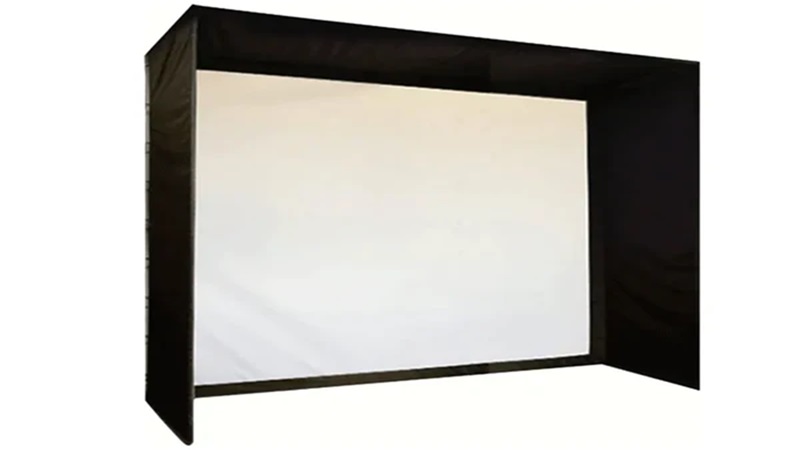
Step 1: Figure Out Your Space First
This is the step most people skip, and it's the one that causes the most regret. Before you look at a single spec sheet, go measure your space — ceiling height included.
The three most common home simulator locations in the US are:
- Garage — the most popular option, especially in the Midwest and South where attached garages are standard. Single-car garages are often workable; two-car garages give you plenty of room.
- Basement — a go-to option in Northern states where finished basements are common. Ceiling height is the main thing to check here. Many unfinished basements run 7–8 feet, which isn't enough. The GOLFJOY P8 requires a minimum of 8.2 feet to swing a driver comfortably.
- Dedicated room or bonus space — less common but ideal if you have it. Above-garage bonus rooms, converted guest rooms, or unused office space all work well.
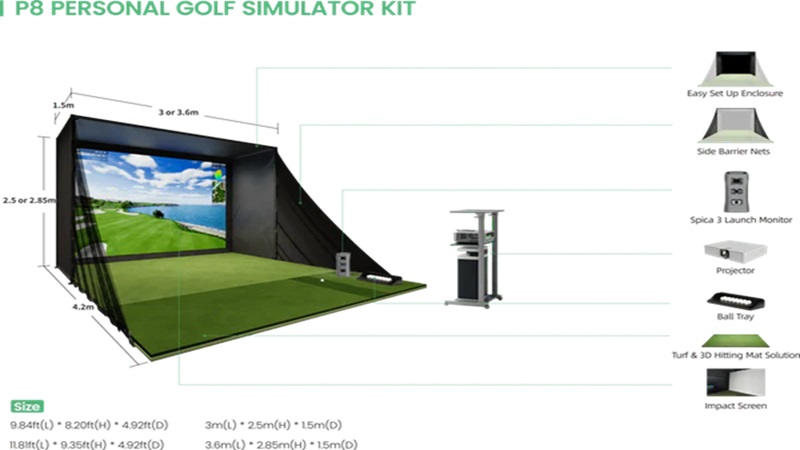
To install a fully functional home simulator, the minimum space required is 9.84 ft (Length) x 17.78 ft (Depth) x 8.20 ft (Height), totaling 175 sq ft. This specific footprint ensures you have enough clearance to swing your driver freely and without restriction.
The GOLFJOY Personal Golf Simulator P8 is designed to fit a wide range of these environments — garage builds, basement setups, and dedicated rooms — without requiring a custom construction project to make it work.
Step 2: Understand the Difference in Tracking Technology
This is where most buyers get confused, and where the biggest performance differences actually live. There are two main tracking approaches you'll encounter:
Radar-based systems (like Mevo+, TrackMan) track the ball using Doppler radar. They're highly accurate for ball data and work well in larger spaces, but they require meaningful depth behind the golfer — which can be a problem in a compact home bay. They also tend to be on the higher end of the price spectrum.
Camera-based systems capture the club and ball at impact using high-speed cameras. They generally require less rear depth than radar, making them better suited to tighter home setups. They're also not affected by the kind of metallic interference that radar can pick up in enclosed spaces.
The GOLFJOY P8 uses camera-based tracking optimized for the dimensions of a real home setup. It measures the data points that matter for both game improvement and just having fun: ball speed, launch angle, clubhead speed, spin rate, carry distance, and club path.
Step 3: Take the Software Seriously
A lot of buyers spend all their time comparing hardware specs and treat the software as an afterthought. Don't. The software is what you're actually looking at every session.
What to look for:
- Course selection — Does it include courses you actually want to play? Pebble Beach, Augusta National, St Andrews? The best platforms offer hundreds of real courses with accurate layouts.
-
Game modes beyond stroke play — Box Crush, closest-to-the-pin, longest drive competitions, and mini-games keep practice from feeling like a chore, especially when you're using it with friends or family.
- Multiplayer — Online play has become a standard feature in US simulator setups. Being able to play a round against a friend in another state is genuinely useful for people who don't always have a regular playing partner nearby.
- Software update cadence — Check whether the platform gets regular updates and new course additions, or if it's essentially frozen once you buy it.
The GOLFJOY P8 integrates with established simulation software that covers all of the above — realistic course play, practice modes, and multiplayer — so your sessions don't go stale after the first month.
Step 4: Think Through the Full Budget — Not Just the Hardware
The launch monitor or simulator unit is only one piece of the cost. Here's what a complete home bay actually involves:
- Launch monitor / simulator system — the core unit
- Impact screen and enclosure frame — a quality impact screen matters a lot for image clarity and durability; cheap screens wrinkle and wear out fast
- Projector — short-throw 4K projectors have become the US standard for home bays; brightness matters more than resolution in most setups
- Hitting mat — replaceability matters here; mats wear down over time, especially around the strike zone
- Computer or compatible device — most simulator software runs on PC; check minimum specs before buying
- Installation and any room prep — electrical outlets, lighting, flooring, wall padding
A realistic all-in budget for a solid home bay in the US ranges from around $8,000 on the lower end to $20,000+ for a premium setup. The GOLFJOY P8 is positioned to give you high-performance tracking and software at a price point that leaves room in the budget for the rest of the build.
Step 5: Factor In Long-Term Value
A home simulator isn't just a purchase — it's a replacement for recurring costs. The average US golfer spending $50–100 per round, plus range fees, plus lessons, adds up fast over a year. For a serious player, a home bay pays for itself in avoided range and green fees within a few years.
Beyond the math, there's a consistency factor. Having a simulator at home means you can hit 30 balls before work, work on your short game on a Tuesday night, or play a round with your kids on a rainy Saturday — without scheduling around tee times or driving to a facility. That regularity is what actually moves the needle on your game.
Durability is part of this equation too. The P8 is built for the kind of regular, high-volume use that a motivated golfer will put it through. This isn't a product that's going to need replacing in two years.
Common Questions Before You Buy
Do I need a professional installer?
It depends on your comfort level with DIY. The GOLFJOY P8 is designed for a manageable installation process — you don't need to be technically advanced to get it set up. That said, if you're doing any room modifications (running new electrical, building out an enclosure frame, mounting overhead components), bringing in help for those specific pieces makes sense.
What ceiling height do I actually need?
8.2 feet is the practical minimum for most golfers swinging a driver. At 8.2 feet you can play, but it's snug. 10 feet gives you real comfort across all clubs. If your space runs 8.5 feet, a simulator is still possible, but you'll want to test your swing first before committing.
How realistic is the data compared to hitting outdoors?
On a quality system like the P8, the core ball flight metrics — ball speed, launch angle, spin — are accurate enough that the distances and shot shapes you see indoors will translate directly to your outdoor game. This is the whole point: you're not just playing a video game, you're getting real feedback on real shots.
Can beginners use it or is it just for serious golfers?
Both. The P8's interface is accessible for someone picking up a club for the first time, and the game modes include options that are fun without being technically demanding. For serious players, the data depth and course selection will keep it relevant for years. It's a setup that works across the household.
Ready to Start Planning Your Build?
The best home simulator setup is the one that fits your space, your game, and your budget — and actually gets used consistently. If you're working through the details of your build or want to talk through whether the GOLFJOY P8 is the right fit for your space, we're happy to walk through it with you.